

Popular culture has upheld the stark dichotomy between work and play for centuries. Play is narrowly viewed as an activity reserved for children while work is viewed as a productive and respectable action that proves an individual’s value. We believe this dichotomy is false and we hope to convince you of the following by the time you finish this article:
- The playfulness of an activity depends solely on a person’s attitude towards the task.
- By understanding an individual’s play identity and shifting around the context of an activity, you can turn nearly any task into play.
Play and Playfulness
Play is a notoriously nebulous topic in academic circles and has to date evaded a clear definition. Our take on this: play is anything that evokes playfulness.
Miguel Sicart, a notable scholar who’s work sheds light on the design and culture of playable media, defines playfulness ‘as a way of engaging with particular contexts and objects that is similar to play but respects the purposes and goals of that object or context’. In other words, playfulness is an attitude towards a task and thus can be imposed on anything by reframing it, structurally and/or aesthetically, to fit an individual’s preferred way of play.
Play Identities
An individual’s personality and preferences for play types shape their unique play identity. In other words, everyone has a unique preferred way of being playful.
The Four Keirsey Temperaments and the Myers Briggs Types are popular ways of categorizing personality types. These personality types were taken even further by David Bartle to create the Four Bartle Types in order to describe the personalities of people in the context of games.
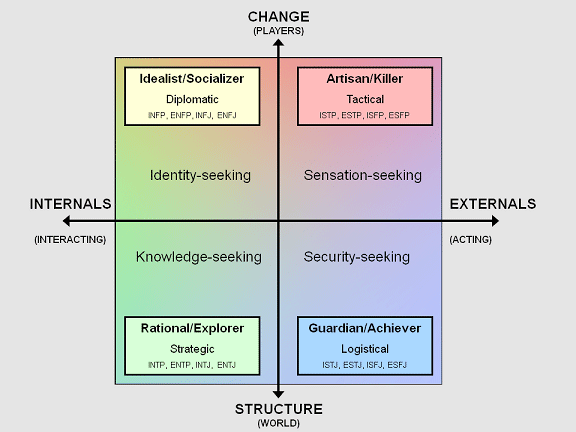
The chart above combines the different categorizations to paint a clearer picture of how these personality interpretations overlap. Picking apart this chart and matching personality type preferences to different mechanics that illicit play for that specific group of people can help you transform any activity into one anyone would find playful.
3 responses to “Everything Can Be Play”
-
Hi Danielle,
Agreed that “play” is a difficult concept to define! When I was doing my master’s, I had a reading in one of my classes around play: Huizinga’s Homo Ludens (Intro or Chapter 1 I believe). I remember it being quite a dense reading, but what I remember from it was the notion of freedom that’s inherent to play.
In Sicart’s definition, I appreciate his inclusion of the aesthetic in his thinking around reframing tasks towards play. I’m thinking you might be able to empathize as a designer :)), but to me, it seems like the aesthetic experience involved in a task–whether a learner is interacting with a beautiful object or whether a task feels pleasurable and enticing to them-is such a critical part of the overall endeavor. Thank you for sharing!
LikeLike
-
While watching your blog, your blog posts will be related to the Toys, and it is essential to have basic knowledge about play. Through your post, I understood that play has been viewed narrowly and realized how it can influence individuals based on attitudes toward the tasks. I also agree that everyone has a unique preference for being playful. I believe that not everyone can find joy in the same way as you said. I am so excited to keep seeing your posts!
LikeLike
-
Hi Danielle, I’m not able to comment on your newest post so will put my comment here. This is a really interesting post about the connection between STEM education and spatial intelligence. I used to teach at a school for the blind and had two colleagues who taught math who were blind. I was fascinated by the way they explained mathematical concepts to students who were totally blind, including students who were totally blind since birth. Since blindness is a spectrum, the classes had a mix of students who could perceive very little light (could maybe tell if the lights were on vs. off) to students with low vision (who used large-text books and handouts). Teaching math in this context required I think particular pedagogical skill especially in regards to how each student perceived and understood space. Thanks for sharing this post!
LikeLike


Leave a Reply